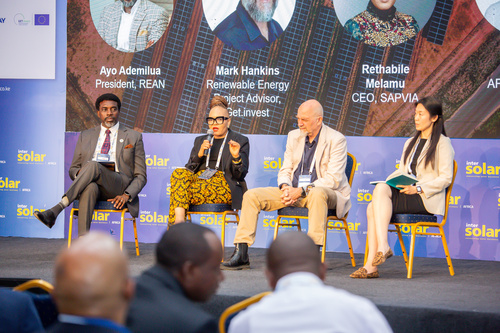
Pforzheim/Nairobi – Intersolar Africa 2026 has successfully concluded at the Sarit Expo Centre in Nairobi, bringing together 81 exhibiting companies and partners and welcoming roughly 3,000 trade visitors and conference delegates from 60 countries across Africa and beyond. The exhibition and conference provided a high-level platform for dialogue, technology exchange, and partnership building across the solar, energy storage, and clean energy ecosystem.
The two-day event underscored East Africa’s growing role in Africa’s energy transition, convening policymakers, developers, investors, manufacturers, EPCs, utilities, and innovators from across the continent and internationally. The exhibition showcased a wide range of photovoltaic, energy storage, grid integration, and e-mobility solutions, while the conference programme featured 21 sessions with 60 speakers, attracting around 200 conference attendees and addressing market development, policy frameworks, financing models, and real-world project deployment.
Discussions throughout the event reflected a shift in how renewable energy is viewed across Kenya and the region - not only as a source of electricity, but as a driver of economic inclusion, productivity, and resilience.
Speaking during the event, Cynthia Angweya-Muhati, CEO of the Kenya Renewable Energy Association (KEREA), highlighted the expanding socio-economic impact of renewable energy solutions.
“In the past we looked at energy as just lighting. But it’s no longer lighting,” she said. “We are now talking about productive uses of renewable energy and regenerative agriculture. Through energy, we are preventing post-harvest losses using cold chains, enabling farmers to pay as they use, and supporting small businesses to operate after dark. Kenya is already doing well - what we now need is to scale up.”
The strong momentum observed at Intersolar Africa 2026 aligns with broader continental trends. According to the Global Solar Council’s second flagship report, Africa Market Outlook for Solar PV, 2025 marked the fastest growth year on record for Africa, with 4.5 GW of new solar PV capacity installed, representing a 54% year-on-year increase.
Leo Echard, Policy Officer at the Global Solar Council, noted that the growth exceeded expectations and reflects a more diversified solar market across the continent.
“4.5 GW is extremely good and 12% above what we forecasted,” he said. “Our model shows 31 GW potentially by 2029, which is huge growth for the solar market. What is particularly interesting is the diversification trend - growth is no longer driven only by South Africa and Egypt, with more countries now surpassing the 100 MW threshold.”
Participants at Intersolar Africa 2026 also emphasized the role of falling technology costs and energy storage in accelerating deployment, particularly across East Africa. David Wedepohl, Managing Director for International Affairs at BSW-Solar (German Solar Association), highlighted the changing market dynamics.
“Africa has always had great potential, but for a long time installations remained limited,” he said. “What we are seeing now, particularly in this region, is a clear uptake driven by lower prices and the availability of storage as a viable technology.”
With strong participation from international exhibitors, regional developers, financiers, and policymakers, Intersolar Africa 2026 concluded as a clear signal of the continent’s readiness to scale solar and energy storage solutions. The event reinforced Nairobi’s role as a strategic convening hub for East Africa and positioned Intersolar Africa as a pan-African platform supporting the next phase of clean energy growth.
Edgar Nyandong
Admedia Communications Ltd.
Email:
edgar@admedia.co.ke
Phone: +254 720 953 219
or
Georg Pflomm
Project Manager, Energy, Environment & Sustainable Economy
AHK Services Eastern Africa Limited I Delegation of German Industry & Commerce for Eastern Africa
Email:
georg.pflomm@kenya-ahk.co.ke
Mobile: +254 740 229 826