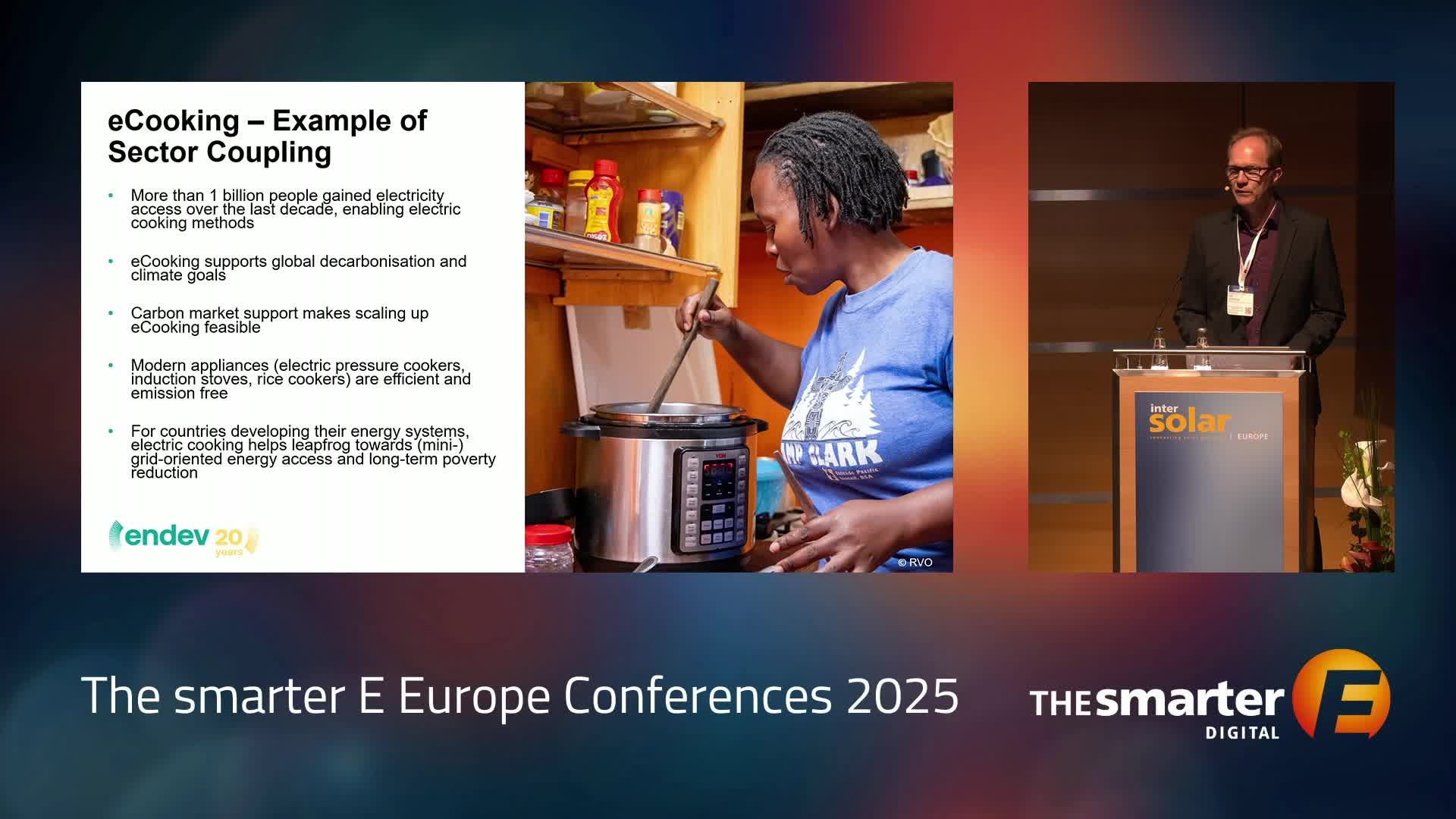
E-Cooking Approaches in the EnDev Programme

premium account

Recording of Wednesday, May 07, 2025 | The smarter E Europe Conferences 2025 | Conference Program | Language: English | Duration: 14:17 .

ENDEV Drives Electric Cooking and Energy Transition Efforts in Sub-Saharan Africa to Support Global Decarbonization Goals

ENDEV is a strategic partnership committed to advancing Sustainable Development Goal 7 and the Paris Agreement by promoting electric cooking as part of modern energy access. This initiative aims at global decarbonization through replacing traditional biomass and fossil fuels with renewable electricity for cooking. Key factors influencing e-cooking adoption include reliable electricity, affordable appliances, cultural acceptance via educational campaigns, local market availability, robust distribution networks in remote areas, and supportive government policies. ENDEV's efforts are illustrated by projects like Cambodia’s Smoke-Free Village initiative that increased e-cooking from 2% to 17%, using behavior change communications rather than financial incentives; and Kenya's tariff study which models tariffs making induction stoves competitive against LPGs while engaging smart appliance suppliers. The Global E-Cooking Accelerator (GEKA), initiated alongside SE4ALL and MEX targets empowering countries towards broader energy transition goals aiming to support five million people by 2030. ENDEV supports both household-level initiatives such as mini-grids/grid densification particularly in Sub-Saharan Africa despite challenges related to daily energy management variability—and institutional e-cooking fostering community awareness about its benefits across schools/health facilities/canteens—while exploring markets with limited electrical infrastructure developing tailored roadmaps for adoption employing results-based financing mechanisms including revolving funds targeting organizations like SACOs amidst transitioning two billion-plus individuals away from polluting biomass sources globally supported within this sectoral shift effort eagerly anticipating future collaborations on these endeavors.

Automated summarization by AI Conver

Speaker

Veit Goehringer
Advisor
GIZ - Deutsche Gesellschaft für Internationale Zusammenarbeit
India

Talk of session: Off-Grid: Electric Cooking, Cooling and Water Treatment

Electric cooking with solar energy is on the rise as both solar and battery technologies continue to improve, making it viable for off-grid homes. One of the main hurdles for solar-powered electric cooking has been energy storage. Cooking typically requires a large amount of energy for a short period, while solar generation is intermittent. However, advancements in lithium-ion and solid-state battery technology have made energy storage more efficient, allowing for cooking after sundown or on cloudy days. The efficiency of electric cooking appliances has also improved: In induction stoves, for example, most of the energy goes directly into heating the pot or pan. Appliances like electric pressure cookers and slow cookers are also energy-efficient. They can be ideal for solar-powered cooking setups, as they require a relatively low, steady energy input over a long period of time. With continuous advancements in solar PV and battery storage, solar electric cooking is likely to spread further in regions where grid access is limited or costly, such as parts of Africa, South Asia, and Latin America. In off-grid areas with limited access to electricity, PV systems are also key for powering refrigerators, freezers, refrigerated containers, and cold rooms. They are particularly valuable in rural or remote settings for storing perishable goods, medicines, and vaccines. New technological developments have significantly increased the efficiency of solar refrigeration systems, minimizing or even eliminating the need for battery power at night and during periods of low sunlight.Solar energy can also be used to purify or treat water to make it safe to drink or for agricultural or industrial use. This method leverages the power of sunlight, either directly or indirectly, to remove contaminants, pathogens, and impurities from water. There is a variety of methods for solar water treatment, ranging from using the sun's UV-A rays and heat to complex solar-powered water filtration systems where PV-generated electricity is used to pump water through advanced filtration systems such as ultrafiltration or RO (reverse osmosis). However, solar water treatment systems are still costly and require advanced technology and expertise.This session will provide an overview of current developments and insights into new applications for solar-powered cooking, cooling and water treatment.

Further Talks of this session:

Welcome & Introduction

Speaker

Deepak Mohapatra
Senior Officer - Business & Market Development
Alliance for Rural Electrification
Belgium

Recording of presentation not authorized for publication.

Cleaner Cooking for People and the Planet - Solar PV Based Options

Speaker

Christa Roth
Director
Food and Fuel Consultants
Germany

To Talk

Local Construction of the First Low Carbon Cold Room In Kenya

Speaker

Géraldine Quelle
Project Manager
Phaesun GmbH
Germany

To Talk

Offgrid World, and the Challenges of Water Sector

Speaker

Anna Shepelenko
COO
Boreal Light GmbH
Germany

To Talk

Much Cooler - Bridging Grid Stability and Food Security

Speaker

Christiane Kragh
CEO
Off-Grid Europe GmbH
Germany

To Talk

Q&A Session

To Talk

Further Content
Publications
Intersolar Solarize Africa Market Report 2023

This third report in the "Solarize Africa Market Report" series investigates current developments on the African continent in general and 16 African national PV markets in detail.

The smarter E Europe Exhibition Program 2025
BeCool: Clean cooling for markets in Kenya

Wednesday, May 07, 2025, 10:30 am - 01:00 pm

The smarter E Europe Exhibition Program 2025 | Exhibition Program

premium account

The smarter E AWARD is one of the most prestigious awards in the energy industry. Once again, numerous companies that have developed visionary and pioneering products and projects that are among the finalists in 2025.

The smarter E Europe Conferences 2025
Offgrid World, and the Challenges of Water Sector

Wednesday, May 07, 2025, 09:00 am - 10:30 am

The smarter E Europe Conferences 2025 | Conference Program

premium account

Electric cooking with solar energy is on the rise as both solar and battery technologies continue to improve, making it viable for off-grid homes. One of the main hurdles for solar-powered electric cooking has been energy storage. Cooking typically requires a large amount of energy for a short period, while solar generation is intermittent. However, advancements in lithium-ion and solid-state battery technology have made energy storage more efficient, allowing for cooking after sundown or on cloudy days. The efficiency of electric cooking appliances has also improved: In induction stoves, for example, most of the energy goes directly into heating the pot or pan. Appliances like electric pressure cookers and slow cookers are also energy-efficient. They can be ideal for solar-powered cooking setups, as they require a relatively low, steady energy input over a long period of time. With continuous advancements in solar PV and battery storage, solar electric cooking is likely to spread further in regions where grid access is limited or costly, such as parts of Africa, South Asia, and Latin America. In off-grid areas with limited access to electricity, PV systems are also key for powering refrigerators, freezers, refrigerated containers, and cold rooms. They are particularly valuable in rural or remote settings for storing perishable goods, medicines, and vaccines. New technological developments have significantly increased the efficiency of solar refrigeration systems, minimizing or even eliminating the need for battery power at night and during periods of low sunlight.Solar energy can also be used to purify or treat water to make it safe to drink or for agricultural or industrial use. This method leverages the power of sunlight, either directly or indirectly, to remove contaminants, pathogens, and impurities from water. There is a variety of methods for solar water treatment, ranging from using the sun's UV-A rays and heat to complex solar-powered water filtration systems where PV-generated electricity is used to pump water through advanced filtration systems such as ultrafiltration or RO (reverse osmosis). However, solar water treatment systems are still costly and require advanced technology and expertise.This session will provide an overview of current developments and insights into new applications for solar-powered cooking, cooling and water treatment.

The smarter E Europe Conferences 2025
Q&A Session of the session Floating Solar Power

Tuesday, May 06, 2025, 02:30 pm - 04:00 pm

The smarter E Europe Conferences 2025 | Conference Program

premium account

Floating solar holds significant potential in regions with abundant water bodies, but practical challenges and high costs have tempered expectations in Europe. While technological advancements are gradually improving feasibility, and companies are even looking for new solutions, such as hybrid-offshore systems, navigating the complexities of deployment, reliability, and financing remains critical for long-term success.This session will discuss:Overview of floating PV market developmentsChallenges, lessons learned and innovative approachesEnvironmental implications of FPV applicationsTechnology innovations & standardization developmentsCost reduction strategies and financing solutions

Webinar
Accelerating C&I: Unlocking Growth in Commercial & Industrial Solar

January 16, 2025

free account

The field of agrivoltaics (Agri-PV) is growing increasingly in Germany and in France. The level of interest from players in agriculture, energy supply and research is rising sharply.

Service Menu
You are using an outdated browser

The website cannot be viewed in this browser. Please open the website in an up-to-date browser such as Edge, Chrome, Firefox, or Safari.