Setting the Scene "Affordability"

premium account

Recording of Wednesday, May 07, 2025 | The smarter E Europe 2025 | Conference Program | Language: English | Duration: 12:03 .

South Africa's Solar PV Market Sees Rapid Growth Amid Energy Insecurity and Financial Incentives

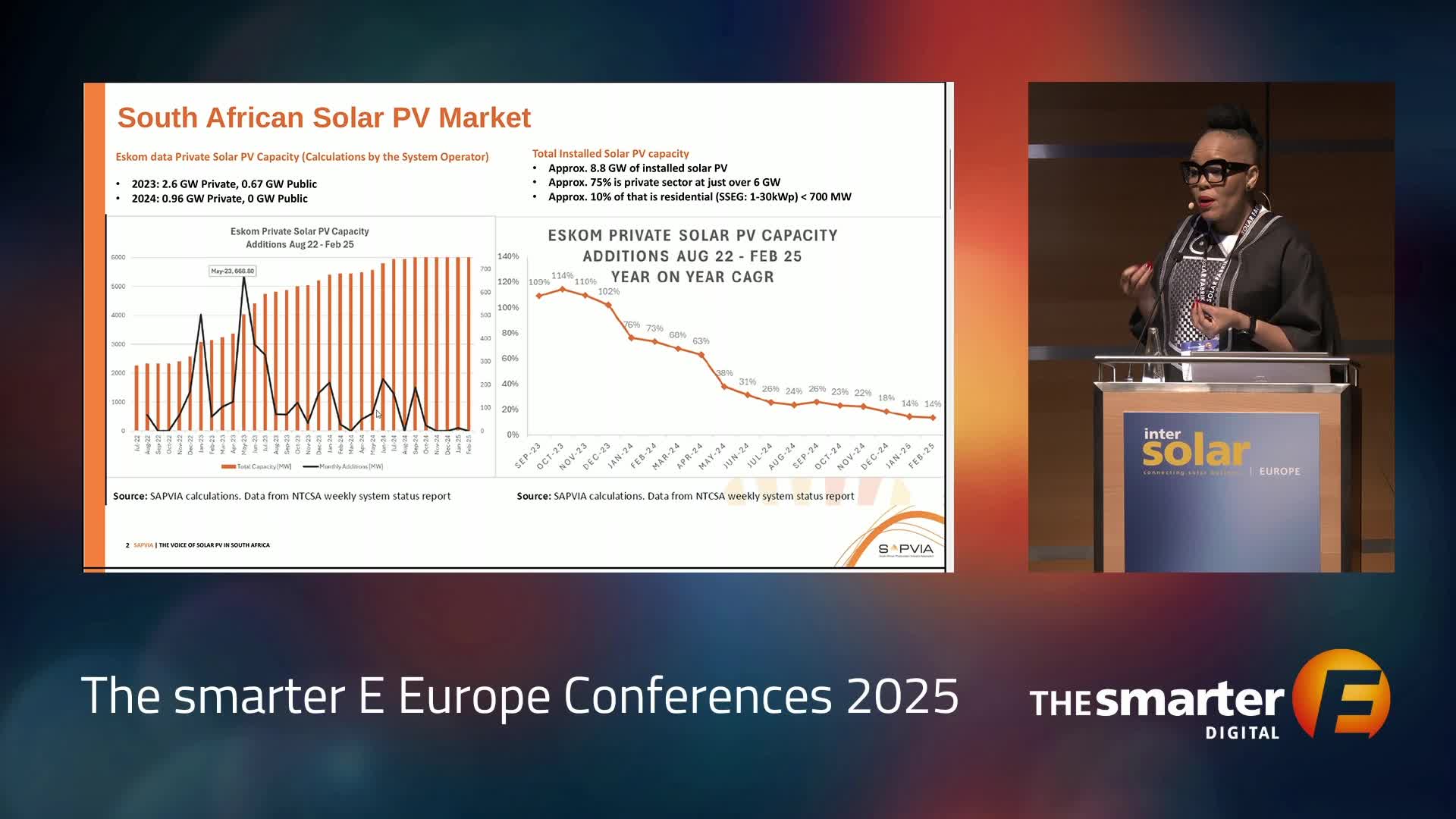
The presentation discusses the financing of solar photovoltaic (PV) systems in South Africa, with a focus on small-scale embedded generation. This sector has become increasingly important, as it helps households mitigate the energy insecurity issues experienced in the past. The speaker represents SAPVIA, a non-profit organization dedicated to promoting the growth of solar PV in South Africa and beyond. As of January 2023, the country had an installed capacity of about 8.8 gigawatts across various market segments. However, residential installations account for only around 0.7 gigawatts. This is partly due to enabling factors such as tax incentives during periods of load shedding, which encouraged adoption, although these incentives have since been discontinued by the government. Businesses, on the other hand, have benefited from attractive incentives, leading to increased deployment among SMEs and commercial facilities. Buyback programs and loans with lower interest rates have improved residential customers’ access to solar PV, promising hopeful prospects for the future. Unreliable electricity supply and frequent load shedding have been significant drivers of this growth. Additional key factors include rising electricity costs, supportive regulatory frameworks, amended legislation, and the unbundling of utilities, all contributing to reduced prices and further adoption. Financing options in these markets are competitive, with banks and energy companies offering mortgages and asset-specific loans for renewable and sustainability projects, further decreasing system costs and prices. In conclusion, Energy Service Companies (ESCOs) play an instrumental role in reducing costs and making solar PV more accessible through rent-to-own and rental models. These allow customers to pay less on their bills and own the asset after a three-year period. Unique models, such as Stockfell saving clubs—which pool resources for collective purchasing—are in their infancy but show great potential for replication across the continent. Finally, the growth of smart grids and off-grid initiatives, driven largely by Eskom’s installation of mini-grids in the Northern Cape and plans for nationwide rollouts in the coming years, highlights the scale of opportunity. The sector is now valued at the equivalent of seventy-five million euros, underscoring the size and potential of the market going forward.

Automated summarization by AI Conver

Rethabile Melamu
CEO
South African Photovoltaic Industry Association
South Africa

Photovoltaic prices have fallen continuously in recent years - a trend that should translate into a growing market for off-grid solutions. Declining costs are crucial for rural electrification in particular, making sustainable energy supply economically viable in remote regions. However, so far many of these price advantages have not yet reached the people that need them most. Do existing framework conditions to foster rural electrification still work in this new market reality? Which measures are needed to ensure that cost reductions reach our target group? This session discusses strategies for improving the availability of low-cost off-grid solutions, financing and innovative business models. A look at successful practical examples shows which political, economic and technological levers need to be pulled to make off-grid PV accessible on a large scale.

Further Talks of this session:

Speaker

Lea Dunst
International Project Manager
BSW - German Solar Association
Germany

To Talk

Speaker

Benjamin Knödler
Head of Private Sector Engagement
BMZ - Federal Ministry for Economic Cooperation and Development
Germany

To Talk

Speaker

Jean Basson
Managing Director
eavion

To Talk

Speaker

David Wedepohl
Managing Director International Affairs
BSW - German Solar Association
Germany

Rethabile Melamu
CEO
South African Photovoltaic Industry Association
South Africa

Felix Boldt
CEO
Solarworx GmbH
Germany

To Talk

Video is not available.

Speaker

Lea Dunst
International Project Manager
BSW - German Solar Association
Germany

Video is not available.

Further Content
Industry News
Policy as a Catalyst for Green Growth in East Africa

January 28, 2026

Across East Africa, well‑designed and consistent public policy is proving essential to accelerating the clean‑energy transition by building investor confidence, enabling new business models, and driving inclusive green growth.

The smarter E Europe Conferences 2025
Offgrid World, and the Challenges of Water Sector

Wednesday, May 07, 2025, 09:00 am - 10:30 am

The smarter E Europe Conferences 2025 | Conference Program

premium account

Electric cooking with solar energy is on the rise as both solar and battery technologies continue to improve, making it viable for off-grid homes. One of the main hurdles for solar-powered electric cooking has been energy storage. Cooking typically requires a large amount of energy for a short period, while solar generation is intermittent. However, advancements in lithium-ion and solid-state battery technology have made energy storage more efficient, allowing for cooking after sundown or on cloudy days. The efficiency of electric cooking appliances has also improved: In induction stoves, for example, most of the energy goes directly into heating the pot or pan. Appliances like electric pressure cookers and slow cookers are also energy-efficient. They can be ideal for solar-powered cooking setups, as they require a relatively low, steady energy input over a long period of time. With continuous advancements in solar PV and battery storage, solar electric cooking is likely to spread further in regions where grid access is limited or costly, such as parts of Africa, South Asia, and Latin America. In off-grid areas with limited access to electricity, PV systems are also key for powering refrigerators, freezers, refrigerated containers, and cold rooms. They are particularly valuable in rural or remote settings for storing perishable goods, medicines, and vaccines. New technological developments have significantly increased the efficiency of solar refrigeration systems, minimizing or even eliminating the need for battery power at night and during periods of low sunlight.Solar energy can also be used to purify or treat water to make it safe to drink or for agricultural or industrial use. This method leverages the power of sunlight, either directly or indirectly, to remove contaminants, pathogens, and impurities from water. There is a variety of methods for solar water treatment, ranging from using the sun's UV-A rays and heat to complex solar-powered water filtration systems where PV-generated electricity is used to pump water through advanced filtration systems such as ultrafiltration or RO (reverse osmosis). However, solar water treatment systems are still costly and require advanced technology and expertise.This session will provide an overview of current developments and insights into new applications for solar-powered cooking, cooling and water treatment.

The smarter E Europe Conferences 2025
Cleaner Cooking for People and the Planet - Solar PV Based Options

Wednesday, May 07, 2025, 09:00 am - 10:30 am

The smarter E Europe Conferences 2025 | Conference Program

premium account

Electric cooking with solar energy is on the rise as both solar and battery technologies continue to improve, making it viable for off-grid homes. One of the main hurdles for solar-powered electric cooking has been energy storage. Cooking typically requires a large amount of energy for a short period, while solar generation is intermittent. However, advancements in lithium-ion and solid-state battery technology have made energy storage more efficient, allowing for cooking after sundown or on cloudy days. The efficiency of electric cooking appliances has also improved: In induction stoves, for example, most of the energy goes directly into heating the pot or pan. Appliances like electric pressure cookers and slow cookers are also energy-efficient. They can be ideal for solar-powered cooking setups, as they require a relatively low, steady energy input over a long period of time. With continuous advancements in solar PV and battery storage, solar electric cooking is likely to spread further in regions where grid access is limited or costly, such as parts of Africa, South Asia, and Latin America. In off-grid areas with limited access to electricity, PV systems are also key for powering refrigerators, freezers, refrigerated containers, and cold rooms. They are particularly valuable in rural or remote settings for storing perishable goods, medicines, and vaccines. New technological developments have significantly increased the efficiency of solar refrigeration systems, minimizing or even eliminating the need for battery power at night and during periods of low sunlight.Solar energy can also be used to purify or treat water to make it safe to drink or for agricultural or industrial use. This method leverages the power of sunlight, either directly or indirectly, to remove contaminants, pathogens, and impurities from water. There is a variety of methods for solar water treatment, ranging from using the sun's UV-A rays and heat to complex solar-powered water filtration systems where PV-generated electricity is used to pump water through advanced filtration systems such as ultrafiltration or RO (reverse osmosis). However, solar water treatment systems are still costly and require advanced technology and expertise.This session will provide an overview of current developments and insights into new applications for solar-powered cooking, cooling and water treatment.

The smarter E Europe Conferences 2025
E-Cooking Approaches in the EnDev Programme

Wednesday, May 07, 2025, 09:00 am - 10:30 am

The smarter E Europe Conferences 2025 | Conference Program

premium account

Electric cooking with solar energy is on the rise as both solar and battery technologies continue to improve, making it viable for off-grid homes. One of the main hurdles for solar-powered electric cooking has been energy storage. Cooking typically requires a large amount of energy for a short period, while solar generation is intermittent. However, advancements in lithium-ion and solid-state battery technology have made energy storage more efficient, allowing for cooking after sundown or on cloudy days. The efficiency of electric cooking appliances has also improved: In induction stoves, for example, most of the energy goes directly into heating the pot or pan. Appliances like electric pressure cookers and slow cookers are also energy-efficient. They can be ideal for solar-powered cooking setups, as they require a relatively low, steady energy input over a long period of time. With continuous advancements in solar PV and battery storage, solar electric cooking is likely to spread further in regions where grid access is limited or costly, such as parts of Africa, South Asia, and Latin America. In off-grid areas with limited access to electricity, PV systems are also key for powering refrigerators, freezers, refrigerated containers, and cold rooms. They are particularly valuable in rural or remote settings for storing perishable goods, medicines, and vaccines. New technological developments have significantly increased the efficiency of solar refrigeration systems, minimizing or even eliminating the need for battery power at night and during periods of low sunlight.Solar energy can also be used to purify or treat water to make it safe to drink or for agricultural or industrial use. This method leverages the power of sunlight, either directly or indirectly, to remove contaminants, pathogens, and impurities from water. There is a variety of methods for solar water treatment, ranging from using the sun's UV-A rays and heat to complex solar-powered water filtration systems where PV-generated electricity is used to pump water through advanced filtration systems such as ultrafiltration or RO (reverse osmosis). However, solar water treatment systems are still costly and require advanced technology and expertise.This session will provide an overview of current developments and insights into new applications for solar-powered cooking, cooling and water treatment.

Publications
Intersolar Solarize Africa Market Report 2023

This third report in the "Solarize Africa Market Report" series investigates current developments on the African continent in general and 16 African national PV markets in detail.

Service Menu
You are using an outdated browser

The website cannot be viewed in this browser. Please open the website in an up-to-date browser such as Edge, Chrome, Firefox, or Safari.