Carbon trading in solar cooking

premium account

Recording of Tuesday, June 23, 2026 | The smarter E Europe Conferences 2026 | Language: English | Duration: 16:48 .

Stefan Zelazny Highlights Clean Cooking and Carbon Trading Dynamics

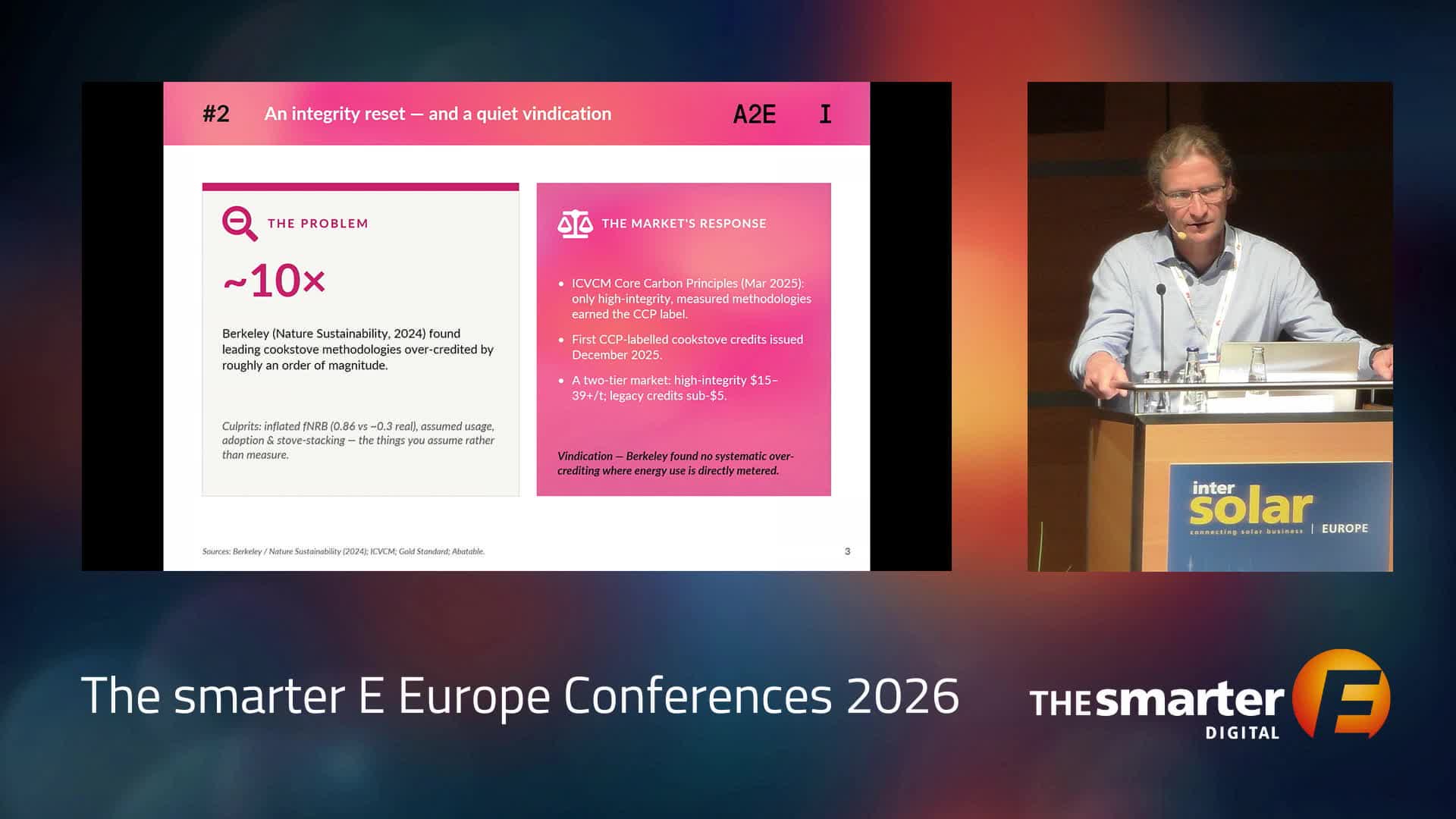
Stefan Zelazny, Managing Director of the Access to Energy Institute, emphasizes technology solutions for energy access in Sub-Saharan Africa, advocating for carbon trading associated with clean cooking solutions. Recent trends indicate significant expansion in carbon-relevant clean practices, affecting voluntary carbon markets, particularly in clean cooking, which holds a valuation between $17 to $20 per ton. However, studies suggest current carbon credit methodologies may overestimate emission reductions, prompting a reevaluation of these measures to restore market confidence. Innovations in Digital Monitoring, Reporting, and Verification (DMRV) are gaining traction, shifting towards more cost-effective frugal metering solutions that utilize smartphones for data transfer. The Energy Access Protocol aims to simplify carbon credit acquisition for smaller developers, enhancing their participation in combating climate change. A new digital protocol streamlines the registration of carbon credits, allowing small projects to efficiently issue credits. Nonetheless, challenges persist, as seen in Cocoa Networks' operational struggles due to reliance on overestimated carbon credits, underscoring the need for measured data in carbon trading.

Automated summarization by AI Conver

Speaker

Stefan Zelazny
Managing Director
Access to Energy Institute
Germany

For many years, the photovoltaic (PV) market was dominated by grid feed-in systems. Increasingly affordable solar modules and storage systems have been changing this picture. The resulting competitive situation is leading to new results when evaluating whether a grid connection makes sense for a particular use or not. However, off-grid applications for thermal energy are also gaining importance, such as solar-electric heating and cooking. Innovative system design as well as innovative storage and applications are shifting into focus.

Further Talks of this session:

Speaker

Prof. Dipl.-Ing. Peter Adelmann
Director
id-eee Institute

To Talk

Speaker

Elisabeth Rüd
Co-Founder & Operations Lead, Feutonix
Ulm University of Applied Sciences
Germany

To Talk

Speaker

Géraldine Quelle
Project Manager
Phaesun GmbH
Germany

To Talk

Speaker

Mithil Barath
Promotions & Communications Coordinator
Asantys Systems GmbH
Germany

To Talk

To Talk

Further Content
The smarter E Europe Exhibition Program 2026
Large Scale Solar Storage and Hybrid Systems for Grid Stability

Tuesday, June 23, 2026, 01:30 pm

The smarter E Europe Exhibition Program 2026 | Exhibition Program

premium account

Grid congestion and renewable growth are reshaping system operation. This session showcases real-world approaches to maintaining stability, from managing network constraints to improving system performance

The smarter E Europe Conferences 2026
HygO & HyTra - Namibia & Südafrika

Tuesday, June 23, 2026, 02:30 pm

The smarter E Europe Conferences 2026 | Conference Program

premium account

Discover how green hydrogen and fuel cell technologies are transforming decentralized energy systems worldwide. This session will be presenting hands-on experience from pioneering projects in Thailand, Ghana, Namibia and South Africa. Find out how solar-powered hydrogen microgrids can replace diesel generators, strengthen energy resilience and enable short- to long-term storage, while supporting environmental and climate goals. Project partners including German SMEs and research institutes, share insights on lessons learned, local benefits and the replication potential of these systems. Selected projects were implemented with the support from the Export Initiative Environmental Protection, a funding programme of the German Federal Ministry for the Environment, Climate Action, Nature Conservation and Nuclear Safety. 

The smarter E Europe Conferences 2026
Is Solar Cooling a Viable Solution for Agricultural Value Chains? - Challenges and Findings From a Field Study in Kenya

Tuesday, June 23, 2026, 11:30 am

The smarter E Europe Conferences 2026 | Conference Program

premium account

For many years, the photovoltaic (PV) market was dominated by grid feed-in systems. Increasingly affordable solar modules and storage systems have been changing this picture. The resulting competitive situation is leading to new results when evaluating whether a grid connection makes sense for a particular use or not. However, off-grid applications for thermal energy are also gaining importance, such as solar-electric heating and cooking. Innovative system design as well as innovative storage and applications are shifting into focus.

The smarter E Europe Conferences 2026
Panel Discussion of the Session: Off-Grid to the Rescue

Tuesday, June 23, 2026, 04:30 pm

The smarter E Europe Conferences 2026 | Conference Program

premium account

In this urgent and forward-looking session of the Intersolar Europe Conference, we bring together voices from the frontlines of decentralized energy: representatives from Syria, Ukraine and Ethiopia - spanning immediate crisis response and longer-term energy market development - alongside practitioners who build and operate these systems at scale. What unites all perspectives is a shared insight: decentralized renewable energy proves its reliability precisely where conventional grids are absent, destroyed or isolated - from war-torn regions to island communities cut off from mainland supply.The initial focus is on the immediate, life-saving needs: hospitals, schools and water supply systems. We then move to the medium-term goal - interconnecting mini-grids, rebuilding resilient infrastructure, creating new jobs and livelihoods. A central question runs through both phases: how do we train local workforces through vocational training, apprenticeships and certification programs, so that rebuilding is not only about hardware, but about people and enduring capacity?Join us to examine how off-grid solar transitions from emergency stop-gap to the sustainable backbone of recovery and growth.

The smarter E Europe Conferences 2026
Panel Discussion of the Session: Solar Made in the EU

Tuesday, June 23, 2026, 02:30 pm

The smarter E Europe Conferences 2026 | Conference Program

premium account

Despite strong research capabilities and the presence of leading production equipment suppliers, Europe has been struggling to rebuild competitive wafer-to-module manufacturing, while the USA and India have enabled a local renaissance in solar manufacturing. In Europe, even long-established inverter manufacturers have been losing considerable ground. With the EU's Net Zero Industry Act yet to deliver momentum, attention is turning to the upcoming Industry Accelerator Act. This session examines how policy, investment and value-chain strategies can strengthen domestic manufacturing and increase internal value creation.Key topics:Overview of EU and national policy frameworks to support local manufacturingStatus of Europe's solar manufacturing value chainInvestment gaps and competitiveness challenges Strategies for triggering a sustainable solar manufacturing revival 

Service Menu
You are using an outdated browser

The website cannot be viewed in this browser. Please open the website in an up-to-date browser such as Edge, Chrome, Firefox, or Safari.