Factors That Influence the Success of a Minigrid Project

premium account

Recording of Wednesday, May 07, 2025 | The smarter E Europe 2025 | Conference Program | Language: English | Duration: 15:05 .

Passion and Business Acumen Propel Nigerian Mini-Grid Project to Success in Tough Market Conditions

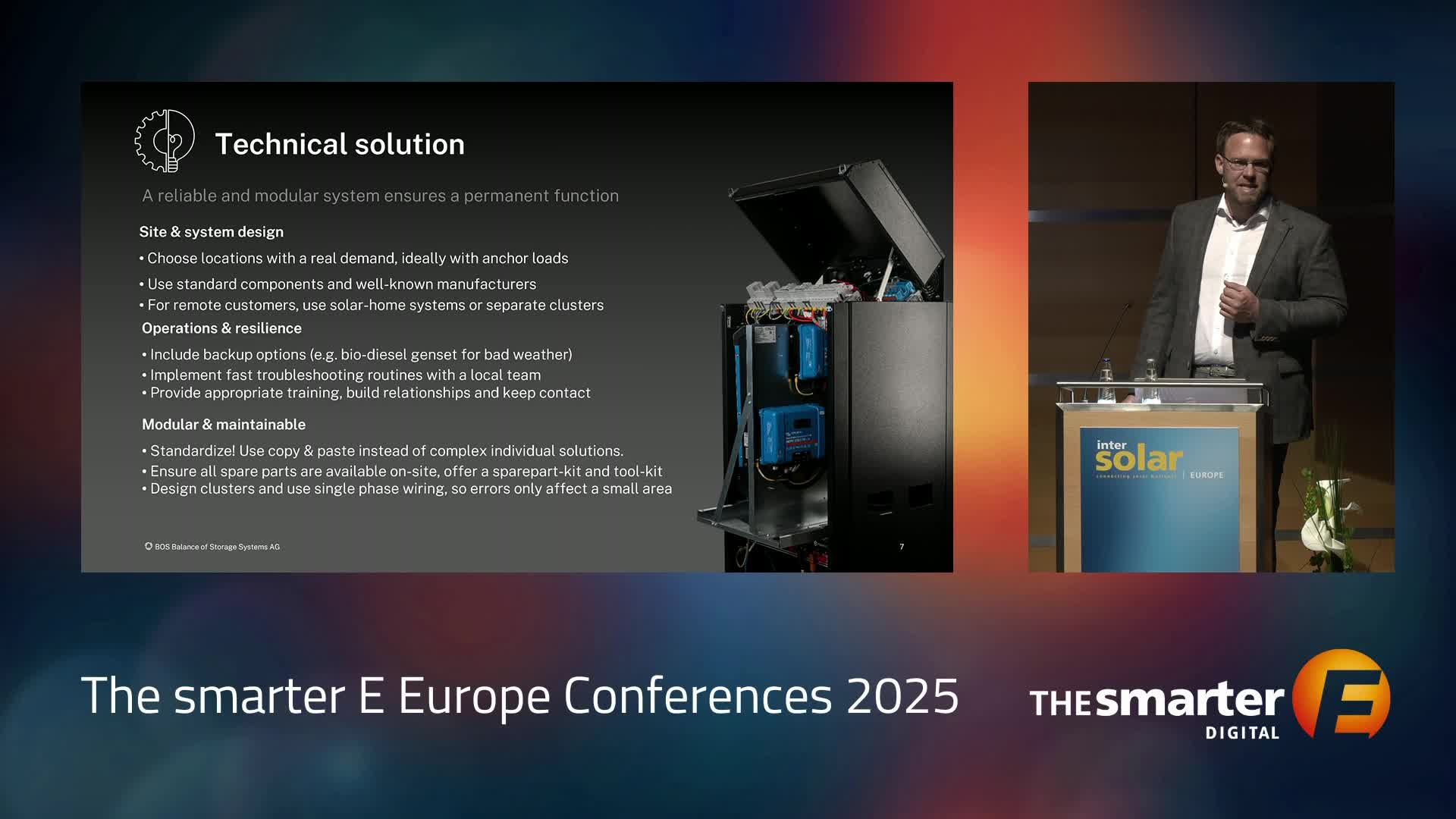
The success of a mini-grid project, as explained by Thomas Kündiger from Balance of Storage Systems AG, relies on several critical factors. The Nigerian mini-grid example serves 12,000 shops using photovoltaics and iron phosphate batteries since 2018. Its success is attributed to adopting a startup mindset that focuses on technical reliability, economic viability, and effective team dynamics—similar to managing risks in startups where technology or financial issues often lead to failure. Technically, selecting sites with real demand such as mills ensures better use cases; standard components enhance robustness in remote areas while separate clusters can be more cost-effective than landlines when needed. Operational resilience is bolstered through backup options for weather variability and efficient troubleshooting routines; well-trained local teams are essential for maintaining strong support networks. Economically viable models must sustain operations beyond initial funding despite competition from public grid pricing—standardized cluster approaches allow scalability without compromising quality or operational understanding among operators who benefit from high-quality tools onsite. Success also depends on motivated operators with an entrepreneurial mindset who understand community energy needs and create revenue streams supporting sustainability. This approach helps tackle challenges like payment defaults or seasonal risks by fostering innovative solutions and potential expansions due to rising demand. Building an effective team involves skilled technicians alongside nurturing leadership among those managing operations locally—a long-term investment crucial for sustained success includes providing standardized photo documentation tools for troubleshooting responsibilities effectively.

Automated summarization by AI Conver

Thomas Kündiger
Chief Technology Manager
Balance of Storage Systems AG
Germany

Off-grid solar systems are often the least expensive option for rural electrification. Solar home systems can power individual households, while mini-grids can supply entire villages. Each comes with its own advantages, disadvantages, and challenges. The aim of this session is to explore challenges as well as success stories. It takes well-functioning components such as battery systems, charge management and inverters to make projects successful. Proper system sizing, maintenance and repair management, as well as a robust financial concept are also necessary. If one of these elements is missing, the electrification will not be sustainable. This session will focus on the aspects mentioned above. The speakers will present successful and unsuccessful approaches and discuss what can be learned from them.

Further Talks of this session:

Speaker

Prof. Dipl.-Ing. Peter Adelmann
Director
id-eee Institute
Germany

To Talk

Speaker

Catherine Adelmann
PhD Candidate
University of Applied Science Ulm
Germany

To Talk

Speaker

Felix Boldt
CEO
Solarworx GmbH
Germany

To Talk

To Talk

Further Content
Industry News
Policy as a Catalyst for Green Growth in East Africa

January 28, 2026

Across East Africa, well‑designed and consistent public policy is proving essential to accelerating the clean‑energy transition by building investor confidence, enabling new business models, and driving inclusive green growth.

The smarter E Europe Conferences 2025
Offgrid World, and the Challenges of Water Sector

Wednesday, May 07, 2025, 09:00 am - 10:30 am

The smarter E Europe Conferences 2025 | Conference Program

premium account

Electric cooking with solar energy is on the rise as both solar and battery technologies continue to improve, making it viable for off-grid homes. One of the main hurdles for solar-powered electric cooking has been energy storage. Cooking typically requires a large amount of energy for a short period, while solar generation is intermittent. However, advancements in lithium-ion and solid-state battery technology have made energy storage more efficient, allowing for cooking after sundown or on cloudy days. The efficiency of electric cooking appliances has also improved: In induction stoves, for example, most of the energy goes directly into heating the pot or pan. Appliances like electric pressure cookers and slow cookers are also energy-efficient. They can be ideal for solar-powered cooking setups, as they require a relatively low, steady energy input over a long period of time. With continuous advancements in solar PV and battery storage, solar electric cooking is likely to spread further in regions where grid access is limited or costly, such as parts of Africa, South Asia, and Latin America. In off-grid areas with limited access to electricity, PV systems are also key for powering refrigerators, freezers, refrigerated containers, and cold rooms. They are particularly valuable in rural or remote settings for storing perishable goods, medicines, and vaccines. New technological developments have significantly increased the efficiency of solar refrigeration systems, minimizing or even eliminating the need for battery power at night and during periods of low sunlight.Solar energy can also be used to purify or treat water to make it safe to drink or for agricultural or industrial use. This method leverages the power of sunlight, either directly or indirectly, to remove contaminants, pathogens, and impurities from water. There is a variety of methods for solar water treatment, ranging from using the sun's UV-A rays and heat to complex solar-powered water filtration systems where PV-generated electricity is used to pump water through advanced filtration systems such as ultrafiltration or RO (reverse osmosis). However, solar water treatment systems are still costly and require advanced technology and expertise.This session will provide an overview of current developments and insights into new applications for solar-powered cooking, cooling and water treatment.

The smarter E Europe Conferences 2025
Cleaner Cooking for People and the Planet - Solar PV Based Options

Wednesday, May 07, 2025, 09:00 am - 10:30 am

The smarter E Europe Conferences 2025 | Conference Program

premium account

Electric cooking with solar energy is on the rise as both solar and battery technologies continue to improve, making it viable for off-grid homes. One of the main hurdles for solar-powered electric cooking has been energy storage. Cooking typically requires a large amount of energy for a short period, while solar generation is intermittent. However, advancements in lithium-ion and solid-state battery technology have made energy storage more efficient, allowing for cooking after sundown or on cloudy days. The efficiency of electric cooking appliances has also improved: In induction stoves, for example, most of the energy goes directly into heating the pot or pan. Appliances like electric pressure cookers and slow cookers are also energy-efficient. They can be ideal for solar-powered cooking setups, as they require a relatively low, steady energy input over a long period of time. With continuous advancements in solar PV and battery storage, solar electric cooking is likely to spread further in regions where grid access is limited or costly, such as parts of Africa, South Asia, and Latin America. In off-grid areas with limited access to electricity, PV systems are also key for powering refrigerators, freezers, refrigerated containers, and cold rooms. They are particularly valuable in rural or remote settings for storing perishable goods, medicines, and vaccines. New technological developments have significantly increased the efficiency of solar refrigeration systems, minimizing or even eliminating the need for battery power at night and during periods of low sunlight.Solar energy can also be used to purify or treat water to make it safe to drink or for agricultural or industrial use. This method leverages the power of sunlight, either directly or indirectly, to remove contaminants, pathogens, and impurities from water. There is a variety of methods for solar water treatment, ranging from using the sun's UV-A rays and heat to complex solar-powered water filtration systems where PV-generated electricity is used to pump water through advanced filtration systems such as ultrafiltration or RO (reverse osmosis). However, solar water treatment systems are still costly and require advanced technology and expertise.This session will provide an overview of current developments and insights into new applications for solar-powered cooking, cooling and water treatment.

The smarter E Europe Conferences 2025
E-Cooking Approaches in the EnDev Programme

Wednesday, May 07, 2025, 09:00 am - 10:30 am

The smarter E Europe Conferences 2025 | Conference Program

premium account

Electric cooking with solar energy is on the rise as both solar and battery technologies continue to improve, making it viable for off-grid homes. One of the main hurdles for solar-powered electric cooking has been energy storage. Cooking typically requires a large amount of energy for a short period, while solar generation is intermittent. However, advancements in lithium-ion and solid-state battery technology have made energy storage more efficient, allowing for cooking after sundown or on cloudy days. The efficiency of electric cooking appliances has also improved: In induction stoves, for example, most of the energy goes directly into heating the pot or pan. Appliances like electric pressure cookers and slow cookers are also energy-efficient. They can be ideal for solar-powered cooking setups, as they require a relatively low, steady energy input over a long period of time. With continuous advancements in solar PV and battery storage, solar electric cooking is likely to spread further in regions where grid access is limited or costly, such as parts of Africa, South Asia, and Latin America. In off-grid areas with limited access to electricity, PV systems are also key for powering refrigerators, freezers, refrigerated containers, and cold rooms. They are particularly valuable in rural or remote settings for storing perishable goods, medicines, and vaccines. New technological developments have significantly increased the efficiency of solar refrigeration systems, minimizing or even eliminating the need for battery power at night and during periods of low sunlight.Solar energy can also be used to purify or treat water to make it safe to drink or for agricultural or industrial use. This method leverages the power of sunlight, either directly or indirectly, to remove contaminants, pathogens, and impurities from water. There is a variety of methods for solar water treatment, ranging from using the sun's UV-A rays and heat to complex solar-powered water filtration systems where PV-generated electricity is used to pump water through advanced filtration systems such as ultrafiltration or RO (reverse osmosis). However, solar water treatment systems are still costly and require advanced technology and expertise.This session will provide an overview of current developments and insights into new applications for solar-powered cooking, cooling and water treatment.

Publications
Intersolar Solarize Africa Market Report 2023

This third report in the "Solarize Africa Market Report" series investigates current developments on the African continent in general and 16 African national PV markets in detail.

Service Menu
You are using an outdated browser

The website cannot be viewed in this browser. Please open the website in an up-to-date browser such as Edge, Chrome, Firefox, or Safari.