GH2GH - Ghana

premium account

Recording of Tuesday, June 23, 2026 | The smarter E Europe Conferences 2026 | Language: English | Duration: 14:05 .

GH2GH Project: Integrating Hydrogen and Solar Energy in Ghana

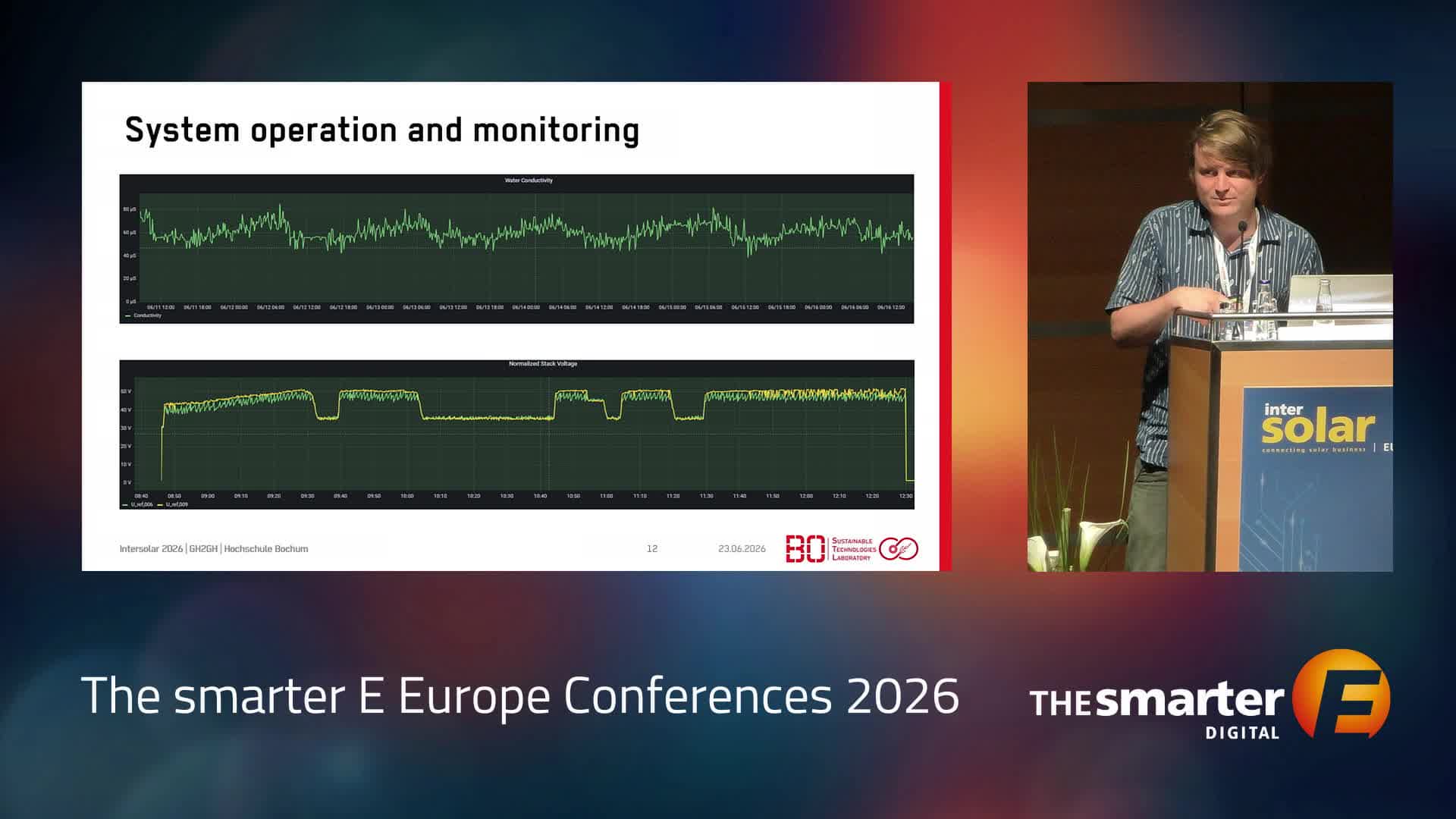
The GH2GH project aims to integrate a hydrogen-based power-to-power system into an existing solar mini-grid in Ghana, enhancing demand and production management. Led by Hochschule Bochum in collaboration with partners like Green Power Brains and SFC Energy, the project seeks to utilize excess solar energy, currently wasted when battery storage is at capacity, by converting it into hydrogen. The hydrogen energy storage system operates under low and high-pressure conditions, allowing significant energy capacity with over 1.2 megawatts of stored chemical energy. The setup involves a solar mini-grid connected to an electrolyzer, prioritizing battery power for efficiency. Performance insights show that the system substitutes diesel with hydrogen energy during low solar production periods, demonstrating its operational effectiveness despite challenges like fluctuating water quality. Evaluations highlight the lifecycle and environmental implications of energy storage systems, showing hydrogen systems can be competitive in certain scenarios, prompting ongoing efforts to optimize costs and efficiency through local personnel training and operational scaling.

Automated summarization by AI Conver

Dr. -Ing. Jonas Pluschke
Research associate
Hochschule Bochum - Sustainable Technologies Laboratory
Germany

Discover how green hydrogen and fuel cell technologies are transforming decentralized energy systems worldwide. This session will be presenting hands-on experience from pioneering projects in Thailand, Ghana, Namibia and South Africa. Find out how solar-powered hydrogen microgrids can replace diesel generators, strengthen energy resilience and enable short- to long-term storage, while supporting environmental and climate goals. Project partners including German SMEs and research institutes, share insights on lessons learned, local benefits and the replication potential of these systems. Selected projects were implemented with the support from the Export Initiative Environmental Protection, a funding programme of the German Federal Ministry for the Environment, Climate Action, Nature Conservation and Nuclear Safety.

Further Talks of this session:

Speaker

Dr. Kathrin Ebner
Tech Lead Hydrogen and E-Mobility
Munich RE
Germany

To Talk

Speaker

Tom Mikus
Programme Manager International Energy Concepts
NOW GmbH / National Organisation for Sustainable Mobility
Germany

To Talk

Speaker

Dr. Mario Lindner
Research Assistent - Transfer and Use of Hydrogen Systems
Fraunhofer Institute for Machine Tools and Forming Technology IWU
Germany

To Talk

Speaker

Manfred Limbrunner
Head of Sales, Marketing & Business Development
H2 Powercell GmbH
Germany

Dr. Philipp Blechinger
Head of Unit Off-Grid Systems
Reiner Lemoine Institut gGmbH
Germany

To Talk

Speaker

Michele Velendric
Director
Green Power Brains GmbH
Germany

Dr. Mario Lindner
Research Assistent - Transfer and Use of Hydrogen Systems
Fraunhofer Institute for Machine Tools and Forming Technology IWU
Germany

Manfred Limbrunner
Head of Sales, Marketing & Business Development
H2 Powercell GmbH
Germany

Dr. Kathrin Ebner
Tech Lead Hydrogen and E-Mobility
Munich RE
Germany

Dr. Philipp Blechinger
Head of Unit Off-Grid Systems
Reiner Lemoine Institut gGmbH
Germany

To Talk

Further Content
Publications
Intersolar Solarize Africa Market Report 2023

This third report in the "Solarize Africa Market Report" series investigates current developments on the African continent in general and 16 African national PV markets in detail.

The smarter E Europe Conferences 2025
Factors That Influence the Success of a Minigrid Project

Wednesday, May 07, 2025, 11:00 am - 12:30 pm

The smarter E Europe Conferences 2025 | Conference Program

premium account

Off-grid solar systems are often the least expensive option for rural electrification. Solar home systems can power individual households, while mini-grids can supply entire villages. Each comes with its own advantages, disadvantages, and challenges. The aim of this session is to explore challenges as well as success stories. It takes well-functioning components such as battery systems, charge management and inverters to make projects successful. Proper system sizing, maintenance and repair management, as well as a robust financial concept are also necessary. If one of these elements is missing, the electrification will not be sustainable. This session will focus on the aspects mentioned above. The speakers will present successful and unsuccessful approaches and discuss what can be learned from them.

The smarter E Europe Conferences 2025
Setting the Scene "Off-Grid"

Wednesday, May 07, 2025, 04:00 pm - 05:30 pm

The smarter E Europe Conferences 2025 | Conference Program

premium account

Photovoltaic prices have fallen continuously in recent years - a trend that should translate into a growing market for off-grid solutions. Declining costs are crucial for rural electrification in particular, making sustainable energy supply economically viable in remote regions. However, so far many of these price advantages have not yet reached the people that need them most. Do existing framework conditions to foster rural electrification still work in this new market reality? Which measures are needed to ensure that cost reductions reach our target group? This session discusses strategies for improving the availability of low-cost off-grid solutions, financing and innovative business models. A look at successful practical examples shows which political, economic and technological levers need to be pulled to make off-grid PV accessible on a large scale.

The smarter E Europe Conferences 2025
Panel Discussion of of the Session Off-Grid: When Will Off-Grid PV Follow the Affordability Trend?(BSW)

Wednesday, May 07, 2025, 04:00 pm - 05:30 pm

The smarter E Europe Conferences 2025 | Conference Program

premium account

Photovoltaic prices have fallen continuously in recent years - a trend that should translate into a growing market for off-grid solutions. Declining costs are crucial for rural electrification in particular, making sustainable energy supply economically viable in remote regions. However, so far many of these price advantages have not yet reached the people that need them most. Do existing framework conditions to foster rural electrification still work in this new market reality? Which measures are needed to ensure that cost reductions reach our target group? This session discusses strategies for improving the availability of low-cost off-grid solutions, financing and innovative business models. A look at successful practical examples shows which political, economic and technological levers need to be pulled to make off-grid PV accessible on a large scale.

Webinar Collection
A New Renewable Energy Knowledge Exchange Partnership: Exploring Collaboration and Investment Opportunities in Rwanda, Zambia, Malawi and Scotland

January 23, 2026

free account

Learn about Malawi, Zambia & Rwanda.

Service Menu
You are using an outdated browser

The website cannot be viewed in this browser. Please open the website in an up-to-date browser such as Edge, Chrome, Firefox, or Safari.